Rural Dairy Queen
I'm Thinking of Ending ThingsThe Rural Dairy Queen is a roadside stop on the drive home with Jake where an everyday search for something to eat gives way to an unexplained warning. Its emptied, close-to-closing interior and a worker the narrator recognizes without knowing why make the location a threshold between the practical journey and a threat that neither Jake nor the narrator can yet explain.
Setting and Approach
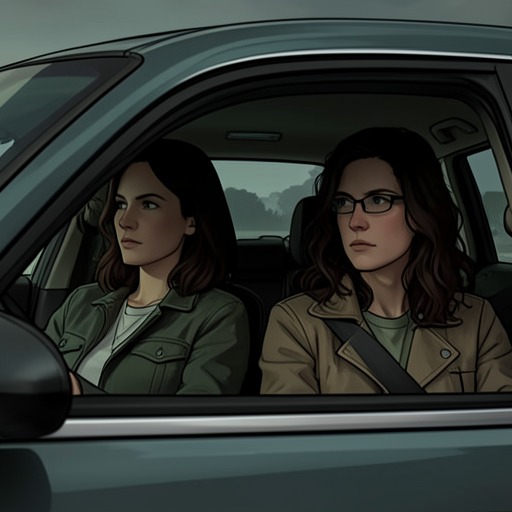
The stop comes after a tiring drive back from Jake’s parents’ place. The conversation has dwindled since the drive there, and outside the car the narrator can barely tell whether snow has begun. She finds the timing of the stop faintly absurd: dessert at Jake’s parents’ place was out of reach because it contained dairy, yet they are now pulling into a Rural Dairy Queen in midwinter to get something to eat. She keeps some of what makes the coincidence funny to herself rather than saying it aloud.
Jake has already settled on a Skor Blizzard, a familiar choice the narrator considers predictable. The parking lot is empty, with a pay-phone booth in one corner and a metal garbage bin in the other. The surviving pay phone catches her attention because most have been removed. These ordinary remnants give the place an oddly paused quality before the encounter inside begins.
The snow grows heavier and blows in swirls rather than settling on the ground. Jake calls it the feel of a big storm, while the narrator thinks ahead to the headache she hopes will be gone by morning and the possibility of shoveling. They have more driving ahead, perhaps more if the storm worsens; staying overnight at the farm had been an option, but she had not felt entirely comfortable there. The Rural Dairy Queen is therefore both a practical stop and a decision point on a journey whose conditions are becoming less predictable.
A Store Prepared to Close
The brightly lit interior makes the narrator feel nauseated. The Rural Dairy Queen is empty, and its tables are clean: no crumpled napkins, used cups, or crumbs remain. The narrator has checked the hours and worked out that closing is eight minutes away. There is no entrance bell or expected overhead music. Instead, the machines and freezers make a sustained metallic drone that reminds her of a dial tone, while an almost chemical smell hangs in the store.
That dial-tone association gives the setting a particular unease without changing its recognizably mundane details. The employees’ workplace is open, but its surfaces and sounds suggest a place already withdrawing from customers for the night. Jake studies the menu and says he is sure they will have something nondairy. He has picked up a long red plastic spoon before the narrator knows whether she can eat anything; the small difference in their attention irritates her. His confidence and her concern about the remaining drive sit beside the approaching storm, making the stop feel less reassuring than its ordinary purpose suggests.
The Employee the Narrator Recognizes
Two girls initially react to Jake and the narrator as if their arrival is unexpectedly familiar. One looks at Jake and whispers to the other; the two laugh. A third girl then comes from the back and, without speaking to them, begins making lemonade for the narrator. The other employees neither address nor acknowledge her. Her arrival changes the encounter from awkward service into something the narrator cannot readily place.
The third girl apologizes for the smell and explains that varnishing is being done in the back. The narrator accepts the explanation, but her attention has shifted: she is certain she knows the girl’s face, hair, and build, though she cannot remember where or when they met. She has never before recognized a perfect stranger in this way. Because the recognition feels too strange to explain to Jake, she says nothing to him. The girl prepares the lemonade by working the machine’s buttons and knobs, holding a cup under it as though waiting in a line; her practical, unhurried movements contrast with the narrator’s mounting certainty that the encounter is significant.
Warning and Narrative Significance
The girl’s unease becomes explicit. Looking down and holding her hands in front of her, she says, “I shouldn’t be saying this, I know I shouldn’t. I know what happens. I’m scared. I know. It’s not good. It’s bad.” When the narrator asks whether she is all right, the girl answers, “You don’t have to go.” She clarifies that she is not afraid for herself, then hands over the cups and says, “For you,” before disappearing back into the kitchen.
The warning attaches danger to departure without explaining what will happen or how the employee knows. That withholding matters: the narrator receives a direct, personal appeal, but no account that could make it understandable or actionable. The approaching storm, the closing store, the unexplained recognition, and the girl’s sudden retreat collect around the possibility that the drive should not continue, while leaving the reason unresolved.
Jake does not mention the girls when they return to the car. The narrator sees him as oblivious and, at times, self-absorbed; his failure to register the encounter leaves her alone with both the warning and the recognition. The Rural Dairy Queen thus serves as more than a stop for food: within a brief, ordinary errand, it introduces knowledge that one person appears to possess and another cannot explain, while the person closest to the narrator remains unaware.